
Importance of Knowing the Surgery Techniques / Notes of Original Breast Surgeries
Revision Breast Lift:
Knowing the previous pedicle technique is crucial for a revision breast lift because it allows the surgeon to protect the existing blood supply to the nipple-areola complex (NAC) and avoid major complications like nipple necrosis and impaired healing.
Importance of Knowing the Previous Pedicle Technique
• Preserving Blood Supply: The primary reason is that a previous breast lift or reduction procedure alters the breast’s natural vascular map by using a specific tissue pedicle to maintain blood flow to the NAC. A new surgeon needs to know which vascular pathways were preserved and which were potentially compromised to plan the revision surgery safely.
• Preventing Complications: Without this information, the surgeon might inadvertently design the new lift or reduction using a different pedicle that relies on the compromised blood vessels, leading to potential tissue death (necrosis), wound healing problems, or sensory loss.
Informed Surgical Planning
Knowledge of the original technique allows the surgeon to:
• Choose the safest approach: They can decide whether to recreate the primary pedicle or use a different technique (e.g., relying on a random pattern blood supply) to ensure optimal Nipple-Areolar Complex (NAC) perfusion.
• Manage scar tissue: Scar tissue from the initial surgery adds complexity, and understanding its location relative to the original pedicle helps navigate this challenge.
• Set realistic expectations: The surgeon can better predict potential outcomes, risks, and limitations of the revision, ensuring transparent communication with the patient.
• Improving Outcomes: Studies suggest that matching the pedicle technique during a secondary surgery may trend toward fewer complications. A well-planned approach based on prior history leads to safer, more predictable, and better aesthetic results.
• Surgeons often request the previous operative notes for these reasons. If the prior pedicle type is unknown, they proceed with extreme caution, often choosing techniques considered safest in such ambiguous scenarios.
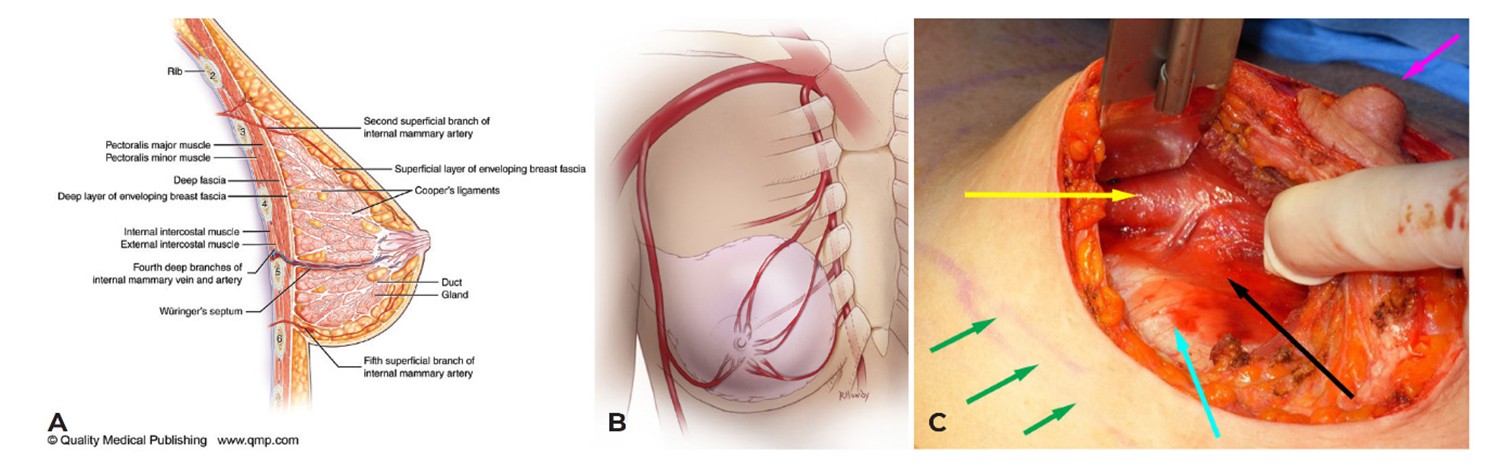
The blood supply to the nipple is superficial. See description below:
(A) The only blood supply that travels through the parenchyma to the nipple is the deep artery and vena comitans that comes up through the fourth interspace. There are branches, but it is important to understand that most of the blood supply to the nipple is in the subcutaneous tissue.
(B) The main blood supply comes from the internal thoracic system and most of it curves up around the breast parenchyma. There is a superficial branch of the lateral thoracic artery, but it often doesn’t reach the nipple.
(C) The deep artery and vena comitans are shown during surgery in the left breast. The green arrows mark the inframammary fold. The light blue arrow marks the fifth rib. The nipple is marked with a pink arrow. The black arrow marks the intercostal muscle and the yellow arrow marks the pectoralis major muscle.
Why does the surgeon need to know the previous implant size and age when doing revision breast augmentation?
You need to know the original implant size during a breast revision to understand how much the breast tissue (skin, muscle, capsule) has stretched, assess for complications like capsular contracture or sagging from oversized implants, ensure the new implant size is appropriate for your frame, and plan for asymmetry correction, guiding the surgeon to select the best size/type for a balanced, natural, and healthy long-term result.
Key Reasons for Knowing Previous Size (Brand if possible) and Age of implants:
• Tissue Stretch & Sagging: Larger implants stretch skin and soft tissues more, potentially causing sagging, which may necessitate a breast lift or fat grafting during revision.
• Capsular Contracture: The tightening of the scar capsule (capsular contracture) can be influenced by implant size; knowing the original helps address firmness and shape issues.
• Body Proportions: A surgeon needs to match the new implant to your unique anatomy (torso, shoulder width, etc.) to avoid disproportion, which means knowing what size was there to understand what should be there now.
• Asymmetry Correction: If one breast stretched more than the other, or if the original placement was uneven, different sizes or shapes might be needed to achieve symmetry.
• Pocket Assessment: The size and condition of the existing implant pocket (where the implant sits) dictates what size and type of new implant can fit comfortably without distortion or malposition.
• Preventing Future Issues: Understanding past sizing helps avoid repeating overly large implants that can accelerate breast aging, causing thinning skin or rippling.
• Knowing the original surgery date: This is very helpful in knowing the type of surgery to be done now. Old implants are best to have a full capsulectomy, even if you feel no pain or hardness. Implants that are only a few years old may be ok to just be removed, not a full capsulectomy (removal of implants along with the capsule and scar tissue)
In essence, knowing the original size provides crucial context for the surgeon to plan the revision, restore breast health, and achieve an optimal aesthetic outcome. However, we understand that it may be difficult to get this information, but, if possible, please try to get this information to help your new surgeon achieve the best results.
Advice for Breast Revision
Patients can take steps before and after treatment to set themselves up for success and the best possible results. It may seem easy to find plastic surgeons who seem like they can “do it all” for breast procedures, but it’s important to look for a surgeon who is well-versed in breast implant revision and performs it often. Medi Makeovers surgeons are in this category.
The procedures can often be more challenging than the original breast augmentation surgery, and so it is important to find a plastic surgeon who routinely performs these operations to get the best outcome, as it is a more complex procedure. Any time you are undergoing a secondary surgery on your breasts, it is important that your surgeon has the information from your previous breast surgery (if possible) in order for them to perform the revision safely. In some cases, the previous surgeon may not be working anymore but the rooms/hospital may have this information.
In today’s digital age, there are so many places that potential patients can go to look for advice or to get a perspective on what the results of their breast implant revision procedure may look like. Yet, it’s important to remember that this procedure is highly customized to the patient, with special considerations taken for their age, surgical history, goals, and unique needs. Know that this surgery is very individualised; what you’ve heard from your friends isn’t necessarily what’s going to happen to you. Let your surgeon give you the correct advice.